相约星期六
每天这样吃饭真的会“加速衰老”,劝你早点改掉!_我的网站

A |
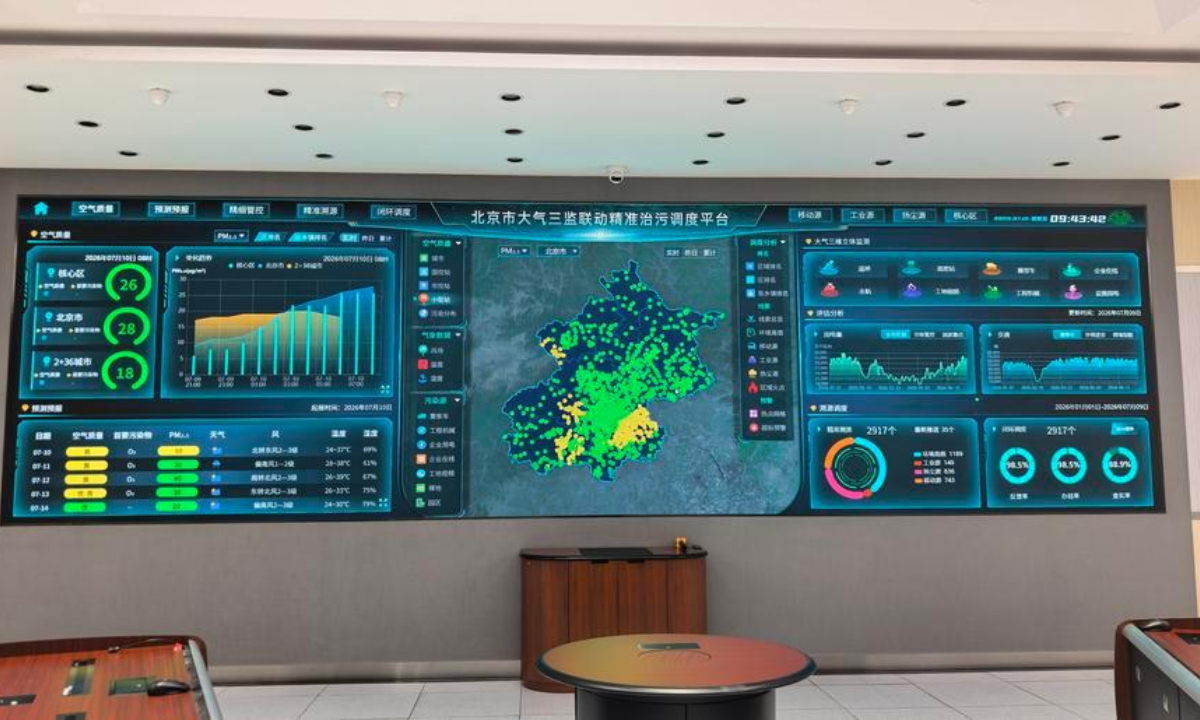
This photo taken on July 10, 2026 shows a data-driven environmental governance system, known as the innovative regulation-monitoring-inspection linkage model, showcased at the Beijing Municipal Ecological and Environmental Monitoring Center in Beijing, capital of China. (Xinhua/Sun Suying)Beijing's blue skies have become a visible sign of the city's progress in tackling air pollution, and behind that progress, digital technologies are playing an increasingly important role.
In 2025, Beijing recorded 311 days with good air quality and only one heavily polluted day, compared with 58 heavily polluted days in 2013, when the city officially began releasing PM2.5 monitoring data. The annual average PM2.5 concentration, a key indicator of air quality, fell from 89.5 micrograms per cubic meter in 2013 to 27 micrograms per cubic meter in 2025, a decline of nearly 70 percent.
The progress has drawn international attention. The United Nations Environment Programme has highlighted Beijing's experience in improving air quality as a model for other cities.
According to experts at the Beijing Municipal Ecological and Environmental Monitoring Center, the cleaner air is the result of a comprehensive system integrating environmental monitoring, scientific analysis, policymaking, regional cooperation and law enforcement -- with digital technologies now woven into every link of that chain.
MORE TARGETED APPROACH
Effective governance begins with accurate monitoring. Beijing has established a multi-level air-quality monitoring network. Figures show 35 standard monitoring stations across the city continuously measure six major pollutants, while more than 1,000 compact sensors deployed across communities and townships provide more detailed information on local air-quality variations.
The monitoring system was gradually built by the Beijing Municipal Ecological and Environmental Monitoring Center, one of China's earliest ecological and environmental monitoring institutions, responsible for monitoring Beijing's air, water, noise, soil environments and ecosystems.
The center has developed an analytical system that can identify around 125 components of PM2.5, covering most of its composition and helping researchers trace pollution sources.
"Source analysis helps us identify the major contributors to pollution at different stages, providing a scientific basis for policymakers to target key emission sources," said Li Yunting, technical director at the center.
Coordinated by the Beijing Municipal Ecology and Environment Bureau, the center has conducted four rounds of PM2.5 source analysis studies with other institutions, with results released in 2014, 2018, 2021 and 2025.
The latest analysis showed that regional transport contributed 57 percent of Beijing's PM2.5 pollution. Among local sources that accounted for the remaining 43 percent, vehicle emissions and residential sources represented the largest share of pollution, a distinctive characteristic of a major international metropolis.
The monitoring results have provided scientific support for a series of pollution-control measures. For example, Beijing has promoted new-energy vehicles to reduce transport emissions and adopted advanced techniques, including air-supported membrane structures, to control dust emissions. Meanwhile, coal combustion pollution, once a major contributor, has almost been eliminated and is no longer listed among the main sources, reflecting broader national efforts to reduce coal consumption, promote clean energy and upgrade heavily polluting industries.
With PM2.5 concentrations now at relatively low levels, further gains in air quality will depend on more targeted, science-driven approaches.
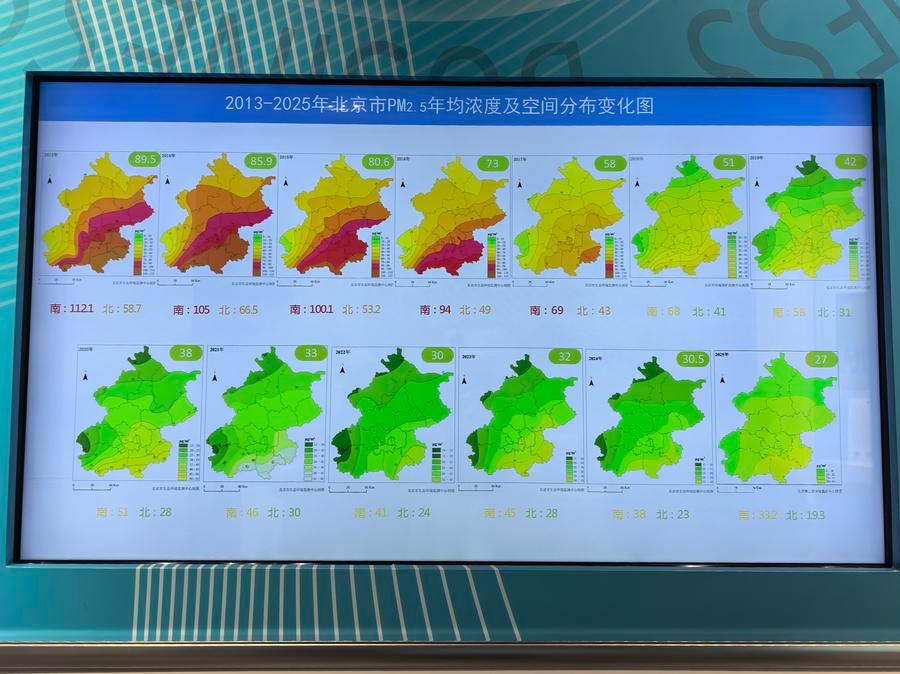
This photo taken on July 10, 2026 at the Beijing Municipal Ecological and Environmental Monitoring Center in Beijing, capital of China, shows the changes in the annual average concentration and spatial distribution of PM2.5 in Beijing from 2013 to 2025. (Xinhua/Sun Suying)
SMARTER ENVIRONMENTAL GOVERNANCE
Beyond monitoring pollution, Beijing has built a data-driven environmental governance system that links monitoring, regulation and enforcement in a closed loop from detection to action and follow-up evaluation.
Developed by the center and known as the innovative regulation-monitoring-inspection linkage model, the system integrates artificial intelligence, the Internet of Things, satellite remote sensing and vehicle-mounted monitoring technologies to pull together environmental data from multiple sources onto a unified platform.
"The system brings information that was once scattered across different departments onto a single platform," said Zhang Likun, director of the smart system division at the center, adding that this enables off-site enforcement and joint cross-sector actions involving housing, water resources and transportation, significantly improving the efficiency and precision of environmental management.
Using more than 30 intelligent algorithms, the platform automatically analyzes data and identifies potential pollution risks, based on which monitoring staff identify the most pressing problems and forward them to enforcement departments.
The approach has already drawn international attention. Clean Air Asia, an international nongovernmental organization focused on improving air quality across Asia, featured the system as a representative case study in its "China Air 2025" report. The model was also presented at the 2026 Better Air Quality Conference and recognized with the Certificate for Clean Air Best Practice Sharing.
China has integrated ecological conservation into its modernization drive. As the country speeds up efforts under the Beautiful China Initiative, Beijing's experience demonstrates how technology can support more precise, coordinated and sustainable environmental governance.
。 据健康时报,如今,越来越多的人开始关注饮食健康,有糖分的不吃、主食类的不吃、碳水多的不吃……在这种趋势下,开始流行起一种饮食方法——“生酮饮食法”。简单来说,生酮饮食的核心在于摄入较高比例的脂肪、适量的蛋白质,以及相对较低的碳水化合物。然而,有很多人直接将生酮饮食简化理解为“不吃主食”。这种看似“健康”的饮食方法,实际上可能正在让自己“加速衰老”!当下流行的轻食,主要为肉类和蔬菜,任璇摄生酮饮食或是一种促衰老饮食!生酮饮食就是利用人体产生的酮体,来替代碳水化合物分解产生的葡萄糖,为人体提供能量。很早以前生酮饮食是被用于治疗儿童难治性癫痫。2024年11月8日,丹麦哥本哈根大学的研究人员在《衰老与疾病》期刊上发表的一项研究发现:较高的血酮水平,尤其是β-羟基丁酸(酮体的一部分)水平较高,与加速大脑认知衰退和增加痴呆死亡率相关。①研究截图换句话说,如果体内酮体水平较高,则会加速我们大脑的衰老和老化。

B | 不仅如此,通过生酮饮食产生较多的酮体也与心脏衰竭、全因死亡率增加有关。2023年8月,哈佛医学院的研究人员在《美国心脏协会杂志》发表的一研究发现:血浆酮体水平升高与心脏衰竭、全因死亡风险升高有关。

C | ②研究截图研究人员分析了1758名老年人的血浆中酮体水平与全因死亡率和心力衰竭发病率之间的关系。结果发现:与血酮水平最低的人相比,酮体水平最高的人,全因死亡风险增加50%,并增加20%心脏衰竭发病率。这些研究都表明:酮体代谢与衰老之间存在潜在的重要关系,生酮饮食或是一种促衰老饮食!沙拉轻食,健康时报寇晓雯 摄每天这样吃饭的人,正在让自己“加速衰老”1. 加速细胞衰老近年来这种生酮饮食法被越来越多的人滥用于减肥、瘦身,看似很健康,其实让自己加速衰老。2024年5月,一项发表在《科学·进展》期刊的研究发现:生酮饮食会促进细胞衰老!研究人员最开始通过小鼠试验发现:21天的生酮饮食会导致小鼠心脏、肾脏、肝脏和大脑等多个器官的细胞衰老;后来在实行了6个月生酮饮食的人类志愿者中,也观察到了类似的细胞衰老和多种相关的促炎分泌因子水平增加。③2. 加速大脑衰老我们的大脑主要依赖于葡萄糖供能,葡萄糖是大脑能量的主要来源。

D | 而很多人一旦减少主食等碳水的摄入,会感觉头脑不清醒、反应迟钝等。

E | 正如上述多个研究中指出,生酮饮食能诱导细胞衰老,特别是对于大脑,与加速大脑认知衰退有关。3. 促进癌症转移很多人听过,“患癌不是最可怕的,癌症发生了转移才是更可怕的”。2024年6月,哥伦比亚大学的研究人员在《科学·进展》期刊上发表了一项关于生酮饮食出人意料的研究发现:生酮饮食竟会促进癌症转移!研究人员对患有乳腺癌的小鼠试验发现,吃生酮饮食的小鼠肺部转移瘤显著增加了。研究结果说明,生酮饮食虽然对抑制原发肿瘤的生长有一定帮助,但是竟会促进癌症的肺转移。④阴影部分小鼠肺部癌症转移显著增加,研究截图4. 增加心血管病风险不仅如此,长期高脂肪摄入的生酮饮食在心血管方面也表现出一定风险。2023年3月,在美国心脏病学会年会和世界心脏病学大会上发表了一项新研究发现:“生酮饮食”不仅可能与血液中“坏胆固醇”(低密度脂蛋白胆固醇)水平较高有关,还可能与心脑血管疾病,如心绞痛、冠脉阻塞以及中风等的发生风险增加2倍相关。⑤研究分析了超过7万名参与者发现:与常规饮食参与者相比,生酮饮食的参与者的低密度脂蛋白胆固醇(“坏胆固醇”)和载脂蛋白B水平明显更高。生酮饮食参与者患心血管疾病的风险高出2倍,包括心脏病发作、中风和外周动脉疾病等。

F | 健康时报寇晓雯 摄官方指南推荐这7种健康主食很多人之所以跟风“生酮饮食”,不吃或少吃主食主要是为了减肥瘦身、控制血糖等。2023年国家卫健委发布的《成人糖尿病食养指南(2023版)》,首都保健营养美食学会副秘书长、注册营养师谷传玲根据《指南》,整理出7种适合控糖的主食,即使血糖不高,也建议跟着吃,因为它们真的很健康。⑥1. 杂粮杂豆饭常见杂粮、杂豆随你挑随你选,是一种还是多种杂粮、杂豆搭配大米做饭也随你喜欢,关键是杂粮杂豆占到1/3~1/2。这里重点推荐三种杂粮,分别是:燕麦、青稞、苦荞麦。燕麦和青稞都富含β-葡聚糖,这是一种水溶性的膳食纤维,溶于水后会增加食物的黏性,延缓胃排空的速度,以及葡萄糖吸收入血的速度,所以用燕麦或青稞替代部分主食有利于控血糖。至于荞麦,用它替代部分主食对控血糖有帮助,跟它作为全谷物富含膳食纤维有关。

G | 杂粮、豆类,韩卫坤摄2. 杂粮杂豆粥很多人都以为血糖高不能喝粥,还真不是。《指南》给各地人群制定的控糖食谱里都有粥,比如玉米糁粥、大米小米粥、百合莲子粥、茯苓红豆薏米粥,燕麦山药粥;也有把牛奶加入粥的,比如牛奶芡实粥、牛奶燕麦粥。仔细分析你会发现,这些粥里要么含有杂粮要么含有杂豆,也就是都属于杂粮杂豆粥。

H | 需要注意的是,做粥时煮熟就行,别煮太烂否则还是容易升血糖的。3. 杂粮馒头杂粮馒头的关键是杂粮面占到1/3~1/2,一顿饭吃大概1~1.5拳头。可以完全用全麦粉做全麦馒头,也可以用小麦粉混着玉米粉、荞麦粉、紫米粉、高粱面做杂粮馒头,除了做馒头,也可以做发糕、窝头或花卷,还可以在面里包上煮熟的红豆、绿豆、芸豆做成豆包,或者在面里拌入蔬菜比如小白菜、香菇和适量蛋白比如豆腐干,做成菜团子。如果自己不会做要买杂粮馒头,最好选预包装的要留意配料表里明确注明杂粮粉含量的,建议含量在30%以上。

I | 杂粮馒头,毛圆圆摄4. 荞麦面条不太建议100%纯苦荞麦面,一是它吃起来比较苦,二是它的价格也较贵,完全可以选荞麦粉在30%~50%之间的荞麦面,剩下的配料如果是全麦粉比如普通全麦粉或者黑全麦粉,就更好了,它们也都富含膳食纤维,跟白面条比也是有利于控血糖的。把荞麦面条作为主食,一顿饭大概吃50-75克(干重)就行,另外还是要搭配充足蔬菜和适量蛋白。5. 五谷和薯类可以蒸的五谷主要就是玉米,建议选甜玉米,它比糯玉米更有利于控糖,一顿吃一根(带芯350-400克)。蒸薯类的话,地瓜、芋头、紫薯、铁棍山药、栗面南瓜都可以,完全作为一顿主食,可以吃到150-200克左右。另外作为一餐,还是要搭配充足蔬菜和适量蛋白质。6. 全麦面包全麦面包相比于白面包还富含膳食纤维和B族维生素,只要你选对吃对,同样也可以帮助控糖。首先,建议选全麦粉含量≥50%的,100%的更好;另外选不要额外添加糖的,营养成分表中脂肪含量最好低于5克/100克的。

J | 每顿吃的量控制在70克-100克,也要搭配充足蔬菜和适量蛋白。

K | 7. 即食燕麦片即食燕麦片和全麦面包一样,它也是可以补充更多膳食纤维和B族维生素的。那即食燕麦片怎么吃才利于控血糖呢?一是控制量,作为一顿主食女性吃40-50克,男性吃50-75克就够了;二是要搭配1.5~2拳头蔬菜,1拳头蛋白。燕麦片,健康时报毛圆圆摄本文综合自:①Circulating Ketone Bodies, Pyruvate, and Citrate and Risk of Cognitive Decline, Structural Brain Abnormalities, and Dementia https://doi.org/10.14336/AD.2024.0754②Elevated Plasma Levels of Ketone Bodies Are Associated WithAll‐Cause Mortality and Incidence of Heart Failure in Older Adults: The CHS https://doi.org/10.1161/JAHA.123.029960③Sung-Jen Wei et al. ,Ketogenic diet induces p53-dependent cellular senescence in multiple organs.Sci. Adv.10,eado1463(2024).DOI:10.1126/sciadv.ado1463④Su Z, Liu Y, Xia Z, Rustgi AK, Gu W. An unexpected role for the ketogenic diet in triggering tumor metastasis by modulating BACH1-mediated transcription. Sci Adv. 2024;10(23):eadm9481. doi:10.1126/sciadv.adm9481⑤‘Keto-Like’ Diet May Be Linked to Higher Risk of Heart Disease, Cardiac Events. Retrieved March 6, 2023 from https://www.acc.org/About-ACC/Press-Releases/2023/03/05/15/07/Keto-Like-Diet-May-Be-Linked-to-Higher-Risk⑥2023-03-08营养师谷传玲《卫健委2023最新指南,推荐控血糖吃这7种主食》。
Current article:http://99r3o7f.zhuaicaisaanzhenshunnaiwei.bond/list_a4n2ip/k2y430.html
Published on:09:59:43


 曼晚:曼联计划夏窗引进一名前锋和门将,以提升球队实力
 神秘“牛来”大模型冲上榜一!暂无厂商认领
 Sisodia at CBI's for questioning in excise policy case
 特朗普政府被曝介入联合国秘书长竞选,美高级官员对当时的6名候选人进行了多次“面试”;美官员:美政府在现有的人选中没有偏好人选
 “桂花蒸”蒸开西湖景区“明星桂”
 Finnish PM Faces Criticism, Scrutiny After Controversial Partying Videos Leaked Online