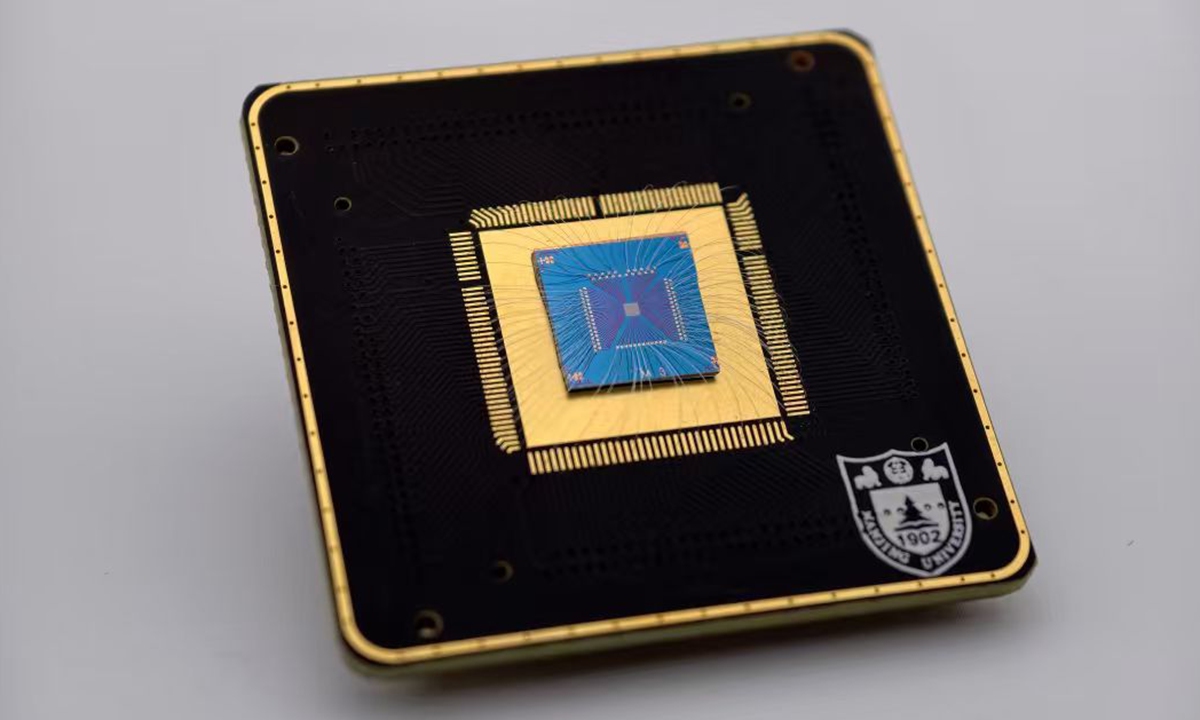
The new ultra-low-power intelligent vision sensor chip "LightTok" developed by a research team from Nanjing University. Photo: from Science and Technology Daily A Chinese research team from Nanjing University has developed a new ultra-low-power intelligent vision sensor chip, dubbed "LightTok," that can convert light signals into tokens within the sensor, significantly reducing the high energy consumption caused by frequent transfers of massive amounts of redundant data, the principal investigator told the Global Times. According to a release from the Institute of Brain-Inspired Intelligence of Nanjing University, tokens generated by the LightTok chip can be directly fed into a Transformer encoder for image recognition. "Our design idea was to move token generation onto the sensor itself, allowing the chip to directly produce tokens that AI models can process once light reaches the sensor," Miao Feng, director of the Institute of Brain-Inspired Intelligence at Nanjing University, told the Global Times on Thursday. "These tokens contain complete image information." Physical AI refers to intelligent systems capable of autonomously perceiving, reasoning, acting and receiving feedback in the real world, representing a key pathway for AI to move from the digital realm into the physical world. Vision-based physical AI systems powered by large AI models need to convert visual information from real-world environments into tokens that can be processed by AI models before feeding these tokens into Transformers for subsequent tasks. In traditional visual perception pipelines, light signals must go through multiple stages, including image sensing, analog-to-digital conversion, data buffering and transfer, digital image patching and embedding, before being transformed into tokens that AI models can process. The frequent transfer of massive amounts of redundant data has resulted in high energy consumption at the edge, according to a report by Science and Technology Daily. The LightTok chip directly addresses a key challenge in physical AI hardware: how to efficiently acquire and tokenize visual information from the physical world with low energy consumption, Miao said. The LightTok chip consists of a photosensitive memory array and peripheral circuits. The team built the array based on single-layer molybdenum disulfide (MoS₂) floating-gate phototransistors, with each pixel capable of sensing light, storing information and performing analog computing. By processing optical information directly within the chip, the device can convert captured visual signals into tokens for AI models, according to the research team. The current LightTok prototype has a resolution of 32×32 pixels, or 1,024 photosensitive pixels, which is still smaller than that of smartphone cameras and industrial imaging systems. However, Miao said the technology is compatible with CMOS manufacturing processes and can be scaled up. With wafer-level growth of molybdenum disulfide materials, the chip could potentially achieve a scale comparable to existing imaging devices. Miao said the chip also draws inspiration from the information-processing mechanism of human vision. Similar to how the retina extracts key visual information before transmitting it to the brain, the chip also aims to process visual information at an early stage. The research was conducted in collaboration with another research team from the National University of Singapore. The findings were published on Wednesday in Nature Sensors, an internationally renowned journal in the field of sensing technology, according to the release. Potential applications for LightTok include drone systems, autonomous remote sensing and small-scale embodied AI systems, Miao said. In these scenarios, devices need to continuously detect, understand and track targets, generating massive amounts of visual data. By reducing the energy required for visual processing, the technology could extend the operating time of drones, satellites and small robots with limited power supplies, the expert said. 。据悉,“Lobo”取自西班牙语“狼”,其最早在1981年Mustang概念车上使用,随后也在1997年墨西哥市场的F-150上应用,此次则是首次应用在北美市场的F-150当中。具体来看,该套件包含全新样式的双条幅LED日行灯、升级发动机舱盖、专属22英寸轮圈、更具运动感的包围、侧翼子板专属标识、新样式的尾灯以及双边共两出式排气布局等等,同时它的尾部也会降低2英寸(50.8毫米),呈现出俯冲的姿态。车身颜色方面,新车将会提供(black)黑色、Atlas Blue(蓝色)、Rapid Red(红色)、Carbonized Gray(灰色)以及Oxford White(白色)供消费者选装。